 Image 1 of 1
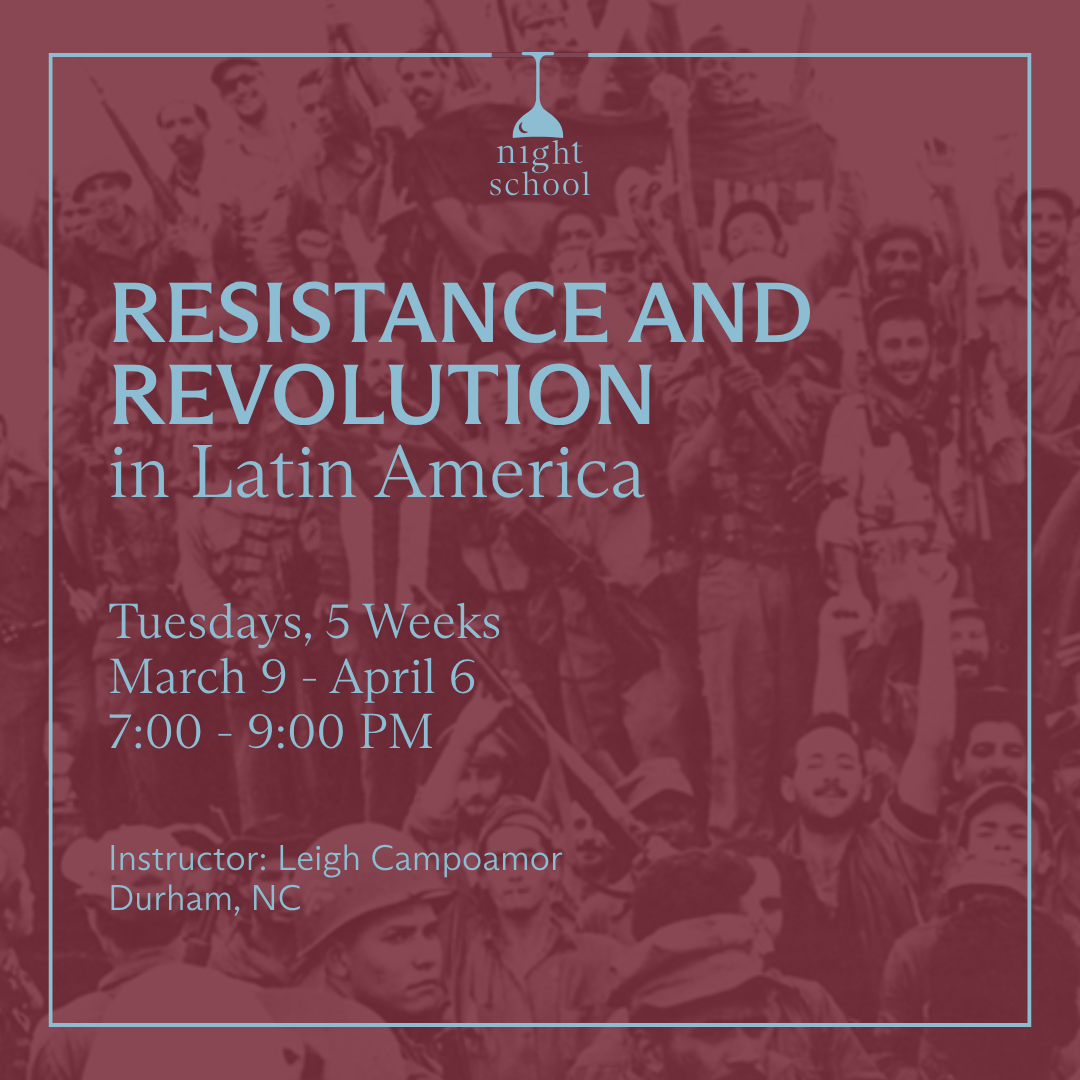
Resistance and Revolution in Latin America (Durham, NC)
**This course is in-person only. There is no virtual component. Participants must be age 21+
Full Tuition: $340 — Sliding-scale tuition options are available in the drop-down enrollment menu for you to self-select. To pay in installments, choose to pay with PayPal or Klarna at check out.
Instructor: Leigh Campoamor | 5 Weeks | Tuesdays | March 9-April 6 | 7:00-9:00 PM | Durham, NC
In the last year, Latin America has been at the forefront of the news as U.S. interests implement new strategies of intervention and many countries in the hemisphere move politically to the right. Yet the people of Latin America have long struggled against such forces—and understanding this is crucial for assessing and confronting the current situation. Together, we’ll learn about key moments in this tradition of popular struggle. You’ll leave with an understanding of the continuities and changes within Latin American social movements that will help you evaluate today’s political climate.
In her 2015 Goldman Environmental Prize acceptance speech, Honduran revolutionary Berta Cáceres proclaimed, “Wake up, humanity! There is no more time.” Less than a year later, she was assassinated and her followers vowed to carry on her legacy—not only as an indigenous woman and feminist, but also as a revolutionary who dared speak out and organize against the violence of capitalist extraction and the fiction of democracy within such a system. This is just one example of the long tradition of popular revolt and revolution in Latin America that we’ll study in this course.
In their struggles for justice, Latin American social movements challenge narrow understandings of concepts like democracy and development—connecting issues such as labor, indigeneity, gender, and the environment to broader critiques of capitalism and the nation-state. In this course, we’ll examine the tradition of Latin American social movements and ask: What exactly are the structures of oppression against which social movements organize? What do we mean when we talk about coloniality, global capitalism, and Western hegemony? Why does the Cuban Revolution hold such an important place both for its champions and enemies? And what does it mean for those of us in the global north to be in solidarity with such movements?
This class consists of short lectures combined with small and large group discussion that incorporates analysis of primary source texts. Students will read approximately 30 pages of out-of-class reading per week.
—
The Fine Print
Gift certificates may only be redeemed at the full tuition tier.
SLIDING SCALE TUITION
We now offer an early-bird low-tier tuition special as a way of incentivizing early enrollment. This is available up to 4 weeks before the class begins. Early enrollment allows us to gauge if a course will meet the minimum number of students required to run the course.
Full tuition is the cost per-student of running the class. If you choose a tier below full tuition, you are receiving a discount. If you choose to make a donation in addition to full tuition, you are helping to cover the cost for students who are not able to pay the full amount.
The mid-level tier is a discounted rate for people whose household income is at or above living wage but who have limited discretionary income.
The low-level tier and the full-scholarship tier are for people whose household income is below living wage or who need extra assistance to meet their needs.
SCHOLARSHIPS
Through our fundraising efforts, we are able to offer three full scholarships per class. The full-scholarship tier is a nonrefundable offering. Each student may only take one full-scholarship class at a time. Because our scholarship funding is limited, if a student selects multiple overlapping classes at the full-scholarship level, they will be disenrolled from all classes.
All sliding-scale and scholarship needs are self-assessed, and we will never request or require proof of need.
Please see our FAQ for more information, including installment plans, refund policy, and sick and inclement weather policy.
**This course is in-person only. There is no virtual component. Participants must be age 21+
Full Tuition: $340 — Sliding-scale tuition options are available in the drop-down enrollment menu for you to self-select. To pay in installments, choose to pay with PayPal or Klarna at check out.
Instructor: Leigh Campoamor | 5 Weeks | Tuesdays | March 9-April 6 | 7:00-9:00 PM | Durham, NC
In the last year, Latin America has been at the forefront of the news as U.S. interests implement new strategies of intervention and many countries in the hemisphere move politically to the right. Yet the people of Latin America have long struggled against such forces—and understanding this is crucial for assessing and confronting the current situation. Together, we’ll learn about key moments in this tradition of popular struggle. You’ll leave with an understanding of the continuities and changes within Latin American social movements that will help you evaluate today’s political climate.
In her 2015 Goldman Environmental Prize acceptance speech, Honduran revolutionary Berta Cáceres proclaimed, “Wake up, humanity! There is no more time.” Less than a year later, she was assassinated and her followers vowed to carry on her legacy—not only as an indigenous woman and feminist, but also as a revolutionary who dared speak out and organize against the violence of capitalist extraction and the fiction of democracy within such a system. This is just one example of the long tradition of popular revolt and revolution in Latin America that we’ll study in this course.
In their struggles for justice, Latin American social movements challenge narrow understandings of concepts like democracy and development—connecting issues such as labor, indigeneity, gender, and the environment to broader critiques of capitalism and the nation-state. In this course, we’ll examine the tradition of Latin American social movements and ask: What exactly are the structures of oppression against which social movements organize? What do we mean when we talk about coloniality, global capitalism, and Western hegemony? Why does the Cuban Revolution hold such an important place both for its champions and enemies? And what does it mean for those of us in the global north to be in solidarity with such movements?
This class consists of short lectures combined with small and large group discussion that incorporates analysis of primary source texts. Students will read approximately 30 pages of out-of-class reading per week.
—
The Fine Print
Gift certificates may only be redeemed at the full tuition tier.
SLIDING SCALE TUITION
We now offer an early-bird low-tier tuition special as a way of incentivizing early enrollment. This is available up to 4 weeks before the class begins. Early enrollment allows us to gauge if a course will meet the minimum number of students required to run the course.
Full tuition is the cost per-student of running the class. If you choose a tier below full tuition, you are receiving a discount. If you choose to make a donation in addition to full tuition, you are helping to cover the cost for students who are not able to pay the full amount.
The mid-level tier is a discounted rate for people whose household income is at or above living wage but who have limited discretionary income.
The low-level tier and the full-scholarship tier are for people whose household income is below living wage or who need extra assistance to meet their needs.
SCHOLARSHIPS
Through our fundraising efforts, we are able to offer three full scholarships per class. The full-scholarship tier is a nonrefundable offering. Each student may only take one full-scholarship class at a time. Because our scholarship funding is limited, if a student selects multiple overlapping classes at the full-scholarship level, they will be disenrolled from all classes.
All sliding-scale and scholarship needs are self-assessed, and we will never request or require proof of need.
Please see our FAQ for more information, including installment plans, refund policy, and sick and inclement weather policy.