 Image 1 of 1
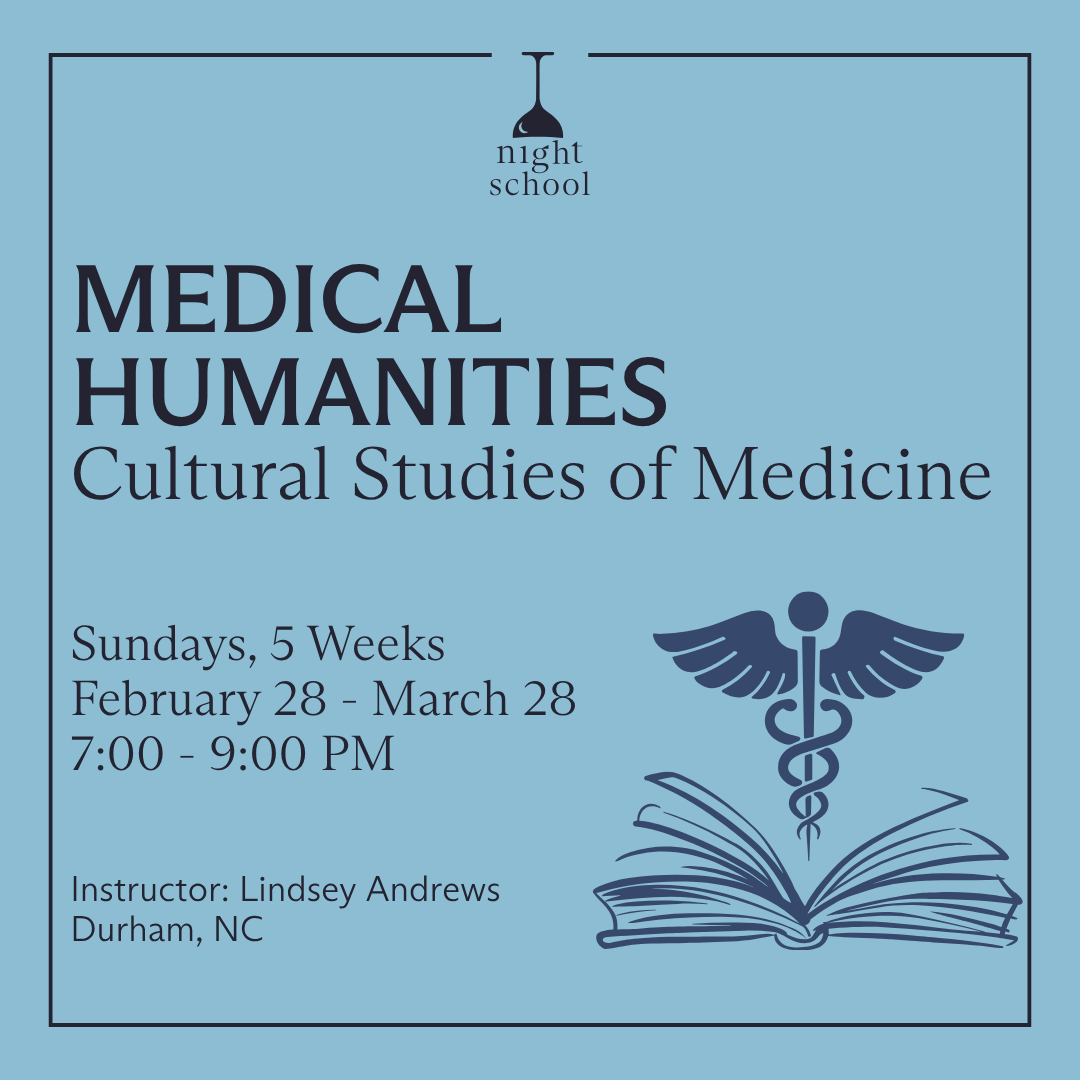
Medical Humanities: Cultural Studies of Medicine (Durham, NC)
**This course is in-person only. There is no virtual component. Participants must be age 21+
Full Tuition: $340 — Sliding-scale tuition options are available in the drop-down enrollment menu for you to self-select. To pay in installments, choose to pay with PayPal or Klarna at check out.
Instructor: Lindsey Andrews | 5 Weeks | Sundays | February 28-March 28| 7:00-9:00 PM | Durham, NC
We are primed to think of medicine as a noble profession: objective science wielded to help us all live healthy, fulfilling lives. But if we take a cultural view of medicine—looking at it through the humanities lenses of history, literature, arts, philosophy, and anthropology—we see that medicine has a complicated past that haunts it today. In this course, you’ll learn about the study of the medical humanities and gain new insights into our systems of care and their alternatives.
Together, we’ll examine the emergence of the contemporary medical system and how it has changed since its origins in the 18th century. We’ll read short stories, personal essays, and case studies that highlight how cultural ideas about race, gender, and class have both shaped medicine, and conversely, been influenced by it. We will discover that despite widespread changes in medical practices, much medical knowledge is still shaped by the histories of racist race science, patriarchal beliefs about women, normalizing taxonomies of sexology, and moralizing ideas about the poor. As it turns out, “health” is far from a neutral category—it is one that has been used to shape the social order, and is intimately tied to disciplinary apparatuses, the carceral system, and economic dispossession.
Together we’ll ask how medicine benefited from experiments on enslaved people, how obstetrics became the purview of primarily male doctors, and how sexology was wrapped up in non-consensual “normalizing” surgeries. We’ll also look at how hygiene laws criminalized the poor and how the rhetoric of public health helped fuel mass incarceration through the war on drugs. Finally, we’ll think about how medical professions have carried forward these racialized, gendered, and classed legacies, and ask how some healthcare professionals and activists are working to change them.
Authors considered will range widely, including: Tressie McMillan Cottom, William Burroughs, Michel Foucault, Charlotte Perkins Gilman, Silvia Federici, Robert J. Lifton, Michelle Murphy, Katrina Karkazis, Erving Goffman, Octavia Butler, Dorothy Roberts, Harriet Washington, Alondra Nelson, and Carl Hart, among others. Readings will consist of about 25-30 pages a week outside of class; in-class time will be a mix of lecture and discussion.
—
The Fine Print
Gift certificates may only be redeemed at the full tuition tier.
SLIDING SCALE TUITION
We now offer an early-bird low-tier tuition special as a way of incentivizing early enrollment. This is available up to 4 weeks before the class begins. Early enrollment allows us to gauge if a course will meet the minimum number of students required to run the course.
Full tuition is the cost per-student of running the class. If you choose a tier below full tuition, you are receiving a discount. If you choose to make a donation in addition to full tuition, you are helping to cover the cost for students who are not able to pay the full amount.
The mid-level tier is a discounted rate for people whose household income is at or above living wage but who have limited discretionary income.
The low-level tier and the full-scholarship tier are for people whose household income is below living wage or who need extra assistance to meet their needs.
SCHOLARSHIPS
Through our fundraising efforts, we are able to offer three full scholarships per class. The full-scholarship tier is a nonrefundable offering. Each student may only take one full-scholarship class at a time. Because our scholarship funding is limited, if a student selects multiple overlapping classes at the full-scholarship level, they will be disenrolled from all classes.
All sliding-scale and scholarship needs are self-assessed, and we will never request or require proof of need.
Please see our FAQ for more information, including installment plans, refund policy, and sick and inclement weather policy.
**This course is in-person only. There is no virtual component. Participants must be age 21+
Full Tuition: $340 — Sliding-scale tuition options are available in the drop-down enrollment menu for you to self-select. To pay in installments, choose to pay with PayPal or Klarna at check out.
Instructor: Lindsey Andrews | 5 Weeks | Sundays | February 28-March 28| 7:00-9:00 PM | Durham, NC
We are primed to think of medicine as a noble profession: objective science wielded to help us all live healthy, fulfilling lives. But if we take a cultural view of medicine—looking at it through the humanities lenses of history, literature, arts, philosophy, and anthropology—we see that medicine has a complicated past that haunts it today. In this course, you’ll learn about the study of the medical humanities and gain new insights into our systems of care and their alternatives.
Together, we’ll examine the emergence of the contemporary medical system and how it has changed since its origins in the 18th century. We’ll read short stories, personal essays, and case studies that highlight how cultural ideas about race, gender, and class have both shaped medicine, and conversely, been influenced by it. We will discover that despite widespread changes in medical practices, much medical knowledge is still shaped by the histories of racist race science, patriarchal beliefs about women, normalizing taxonomies of sexology, and moralizing ideas about the poor. As it turns out, “health” is far from a neutral category—it is one that has been used to shape the social order, and is intimately tied to disciplinary apparatuses, the carceral system, and economic dispossession.
Together we’ll ask how medicine benefited from experiments on enslaved people, how obstetrics became the purview of primarily male doctors, and how sexology was wrapped up in non-consensual “normalizing” surgeries. We’ll also look at how hygiene laws criminalized the poor and how the rhetoric of public health helped fuel mass incarceration through the war on drugs. Finally, we’ll think about how medical professions have carried forward these racialized, gendered, and classed legacies, and ask how some healthcare professionals and activists are working to change them.
Authors considered will range widely, including: Tressie McMillan Cottom, William Burroughs, Michel Foucault, Charlotte Perkins Gilman, Silvia Federici, Robert J. Lifton, Michelle Murphy, Katrina Karkazis, Erving Goffman, Octavia Butler, Dorothy Roberts, Harriet Washington, Alondra Nelson, and Carl Hart, among others. Readings will consist of about 25-30 pages a week outside of class; in-class time will be a mix of lecture and discussion.
—
The Fine Print
Gift certificates may only be redeemed at the full tuition tier.
SLIDING SCALE TUITION
We now offer an early-bird low-tier tuition special as a way of incentivizing early enrollment. This is available up to 4 weeks before the class begins. Early enrollment allows us to gauge if a course will meet the minimum number of students required to run the course.
Full tuition is the cost per-student of running the class. If you choose a tier below full tuition, you are receiving a discount. If you choose to make a donation in addition to full tuition, you are helping to cover the cost for students who are not able to pay the full amount.
The mid-level tier is a discounted rate for people whose household income is at or above living wage but who have limited discretionary income.
The low-level tier and the full-scholarship tier are for people whose household income is below living wage or who need extra assistance to meet their needs.
SCHOLARSHIPS
Through our fundraising efforts, we are able to offer three full scholarships per class. The full-scholarship tier is a nonrefundable offering. Each student may only take one full-scholarship class at a time. Because our scholarship funding is limited, if a student selects multiple overlapping classes at the full-scholarship level, they will be disenrolled from all classes.
All sliding-scale and scholarship needs are self-assessed, and we will never request or require proof of need.
Please see our FAQ for more information, including installment plans, refund policy, and sick and inclement weather policy.