 Image 1 of 1
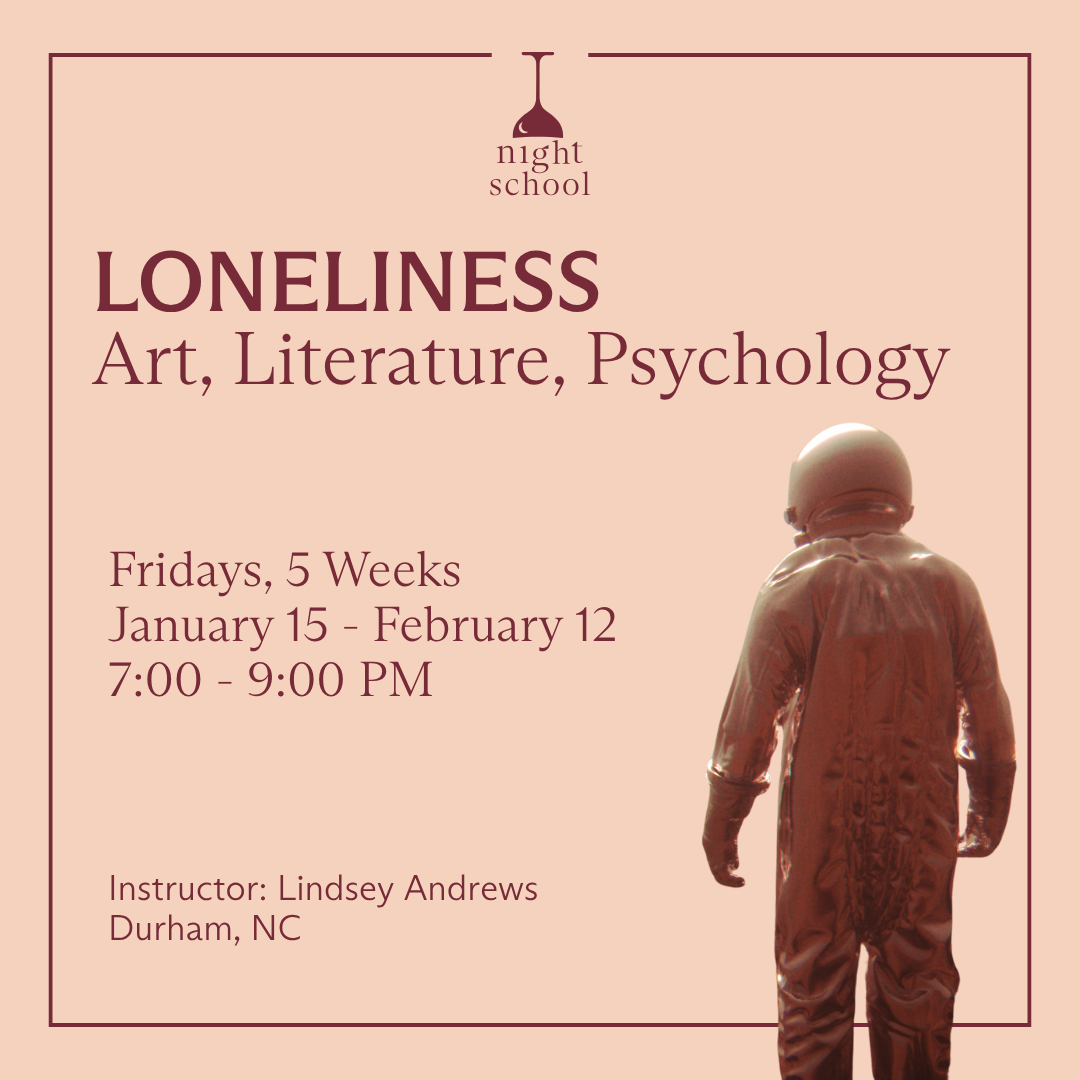
Loneliness: Art, Literature, Psychology (Durham, NC)
**This course is in-person only. There is no virtual component. Participants must be age 21+
Full Tuition: $340 — Sliding-scale tuition options are available in the drop-down enrollment menu for you to self-select. To pay in installments, choose to pay with PayPal or Klarna at check out.
Instructor: Lindsey Andrews | 5 Weeks | Fridays | January 15-February 12 | 7:00-9:00 PM | Durham, NC
As the coldest, darkest season of the year approaches, many people feel acutely aware of their loneliness. In this class, we’ll track the cultural history of loneliness and read literature and examine philosophy that give insight into our current condition. By the end of the course, you’ll have a better understanding of the structural causes of loneliness and a community to examine it with.
According to one survey, as many as half of all Americans say they sometimes or always feel lonely or that no one knows them well. Is widespread cultural loneliness new? Is it getting worse? Why are some people lonelier than others? And why do some people feel existentially lonely, as though loneliness is a core part of who they are? Across this course, we’ll ask these philosophical and cultural questions. We’ll also study how structures of oppression such as racism and ableism enforce loneliness, both ideologically and in terms of the built environment, through single family homes, redlining, and inaccessible buildings.
Together, we’ll try to figure out who benefits from our loneliness and what we can do about it. We’ll consider how writers have used language in response to their feelings of isolation and disconnection. Is writing about loneliness connective or does it magnify one’s sense of being alone? What is the difference between loneliness and solitude? How do structural forces of race, class, and gender affect our capacity to feel connected? Use this opportunity to meet new people at the bar, and imagine new forms of friendship, comradeship, and collectivity.
Readings will be drawn from authors such as: Claudia Rankine, Ashon Crawley, Michael Cobb, Sylvia Plath, Virginia Woolf, Emily Dickinson, and Fay Bound Alberti, among others. Class will be discussion-oriented, guided by readings and mini-lectures. There will be approximately 25-30 pages out of out-of-class reading per week.
—
The Fine Print
Gift certificates may only be redeemed at the full tuition tier.
SLIDING SCALE TUITION
We now offer an early-bird low-tier tuition special as a way of incentivizing early enrollment. This is available up to 4 weeks before the class begins. Early enrollment allows us to gauge if a course will meet the minimum number of students required to run the course.
Full tuition is the cost per-student of running the class. If you choose a tier below full tuition, you are receiving a discount. If you choose to make a donation in addition to full tuition, you are helping to cover the cost for students who are not able to pay the full amount.
The mid-level tier is a discounted rate for people whose household income is at or above living wage but who have limited discretionary income.
The low-level tier and the full-scholarship tier are for people whose household income is below living wage or who need extra assistance to meet their needs.
SCHOLARSHIPS
Through our fundraising efforts, we are able to offer three full scholarships per class. The full-scholarship tier is a nonrefundable offering. Each student may only take one full-scholarship class at a time. Because our scholarship funding is limited, if a student selects multiple overlapping classes at the full-scholarship level, they will be disenrolled from all classes.
All sliding-scale and scholarship needs are self-assessed, and we will never request or require proof of need.
Please see our FAQ for more information, including installment plans, refund policy, and sick and inclement weather policy.
**This course is in-person only. There is no virtual component. Participants must be age 21+
Full Tuition: $340 — Sliding-scale tuition options are available in the drop-down enrollment menu for you to self-select. To pay in installments, choose to pay with PayPal or Klarna at check out.
Instructor: Lindsey Andrews | 5 Weeks | Fridays | January 15-February 12 | 7:00-9:00 PM | Durham, NC
As the coldest, darkest season of the year approaches, many people feel acutely aware of their loneliness. In this class, we’ll track the cultural history of loneliness and read literature and examine philosophy that give insight into our current condition. By the end of the course, you’ll have a better understanding of the structural causes of loneliness and a community to examine it with.
According to one survey, as many as half of all Americans say they sometimes or always feel lonely or that no one knows them well. Is widespread cultural loneliness new? Is it getting worse? Why are some people lonelier than others? And why do some people feel existentially lonely, as though loneliness is a core part of who they are? Across this course, we’ll ask these philosophical and cultural questions. We’ll also study how structures of oppression such as racism and ableism enforce loneliness, both ideologically and in terms of the built environment, through single family homes, redlining, and inaccessible buildings.
Together, we’ll try to figure out who benefits from our loneliness and what we can do about it. We’ll consider how writers have used language in response to their feelings of isolation and disconnection. Is writing about loneliness connective or does it magnify one’s sense of being alone? What is the difference between loneliness and solitude? How do structural forces of race, class, and gender affect our capacity to feel connected? Use this opportunity to meet new people at the bar, and imagine new forms of friendship, comradeship, and collectivity.
Readings will be drawn from authors such as: Claudia Rankine, Ashon Crawley, Michael Cobb, Sylvia Plath, Virginia Woolf, Emily Dickinson, and Fay Bound Alberti, among others. Class will be discussion-oriented, guided by readings and mini-lectures. There will be approximately 25-30 pages out of out-of-class reading per week.
—
The Fine Print
Gift certificates may only be redeemed at the full tuition tier.
SLIDING SCALE TUITION
We now offer an early-bird low-tier tuition special as a way of incentivizing early enrollment. This is available up to 4 weeks before the class begins. Early enrollment allows us to gauge if a course will meet the minimum number of students required to run the course.
Full tuition is the cost per-student of running the class. If you choose a tier below full tuition, you are receiving a discount. If you choose to make a donation in addition to full tuition, you are helping to cover the cost for students who are not able to pay the full amount.
The mid-level tier is a discounted rate for people whose household income is at or above living wage but who have limited discretionary income.
The low-level tier and the full-scholarship tier are for people whose household income is below living wage or who need extra assistance to meet their needs.
SCHOLARSHIPS
Through our fundraising efforts, we are able to offer three full scholarships per class. The full-scholarship tier is a nonrefundable offering. Each student may only take one full-scholarship class at a time. Because our scholarship funding is limited, if a student selects multiple overlapping classes at the full-scholarship level, they will be disenrolled from all classes.
All sliding-scale and scholarship needs are self-assessed, and we will never request or require proof of need.
Please see our FAQ for more information, including installment plans, refund policy, and sick and inclement weather policy.