 Image 1 of 2
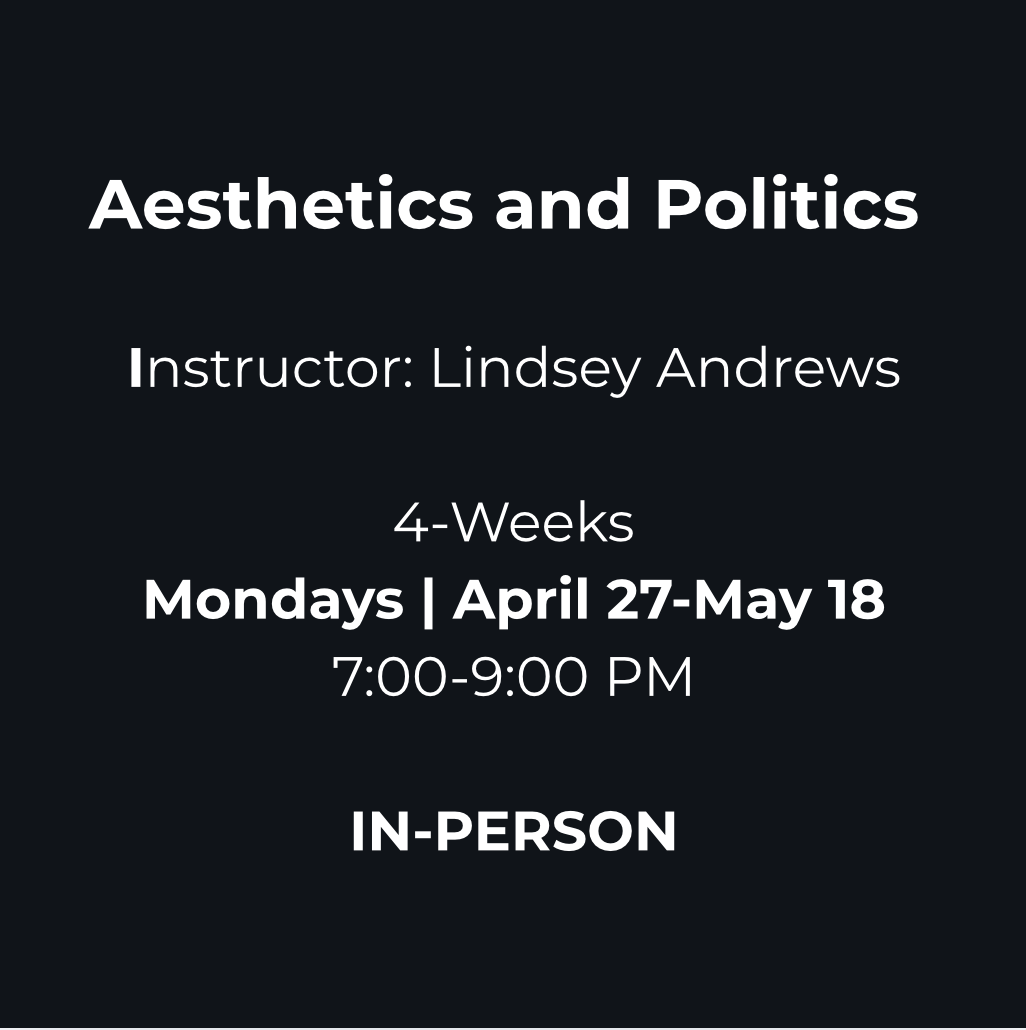 Image 2 of 2
**This course is in-person only. There is no virtual component. Participants must be age 21+
Full Tuition: $275 — Sliding-scale tuition options are available in the drop-down enrollment menu for you to self-select. To pay in installments, choose PayPal or Klarna at check out.
Instructor: Lindsey Andrews | 4-Weeks | Mondays | April 27-May 18 | 7:00-9:00 PM | 719 N Mangum St, Durham, NC
According to social media, “aesthetics” refers to the merely superficial–that is, how things look–and de-influencers will tell you that caring about it is a corporate trap. But is that really what aesthetics–a philosophical approach to art and beauty–is about? How is aesthetics political? What kind of politics are we engaged in when we talk about appearances? Why should we study and make judgments about art? And what’s so wrong with beauty!?
For some philosophers, aesthetic judgments are indeed those that require us to bracket the rest of the world. For them, at the heart of our aesthetic faculties is a capacity to make decisions about prettiness or ugliness or cuteness or boringness. For others, aesthetics plays a role in disguising or activating the political valences of modernity. And for others still, aesthetics names the very arrangement of our senses: something we can make and remake, with revolutionary potential. Aesthetics, then, can have radical consequences for how we understand, experience, and lead meaningful collective lives.
Over the course of four weeks, we’ll read foundational texts in aesthetic theory as well as contemporary critical approaches. We’ll begin with the Enlightenment origins of philosophical aesthetics, travel through 19th century political-economic interventions, study the perceptive effects of the World Wars and global decolonization, engage with the possibilities of feminist performance, and come right up to the present moment, when major thinkers are reclaiming its political possibilities. Authors read may include: Kant, Hume, Marx, Goldman, Benjamin, Arendt, Cesaire, Fanon, Cixous, Butler, Massumi, and Moten. You’ll come away with a deeper comprehension of the philosophical grounds of aesthetics, as well as an expansive understanding of what art is and the deeply political capacities of our senses and sensations.
—
SLIDING SCALE TUITION
Full tuition is the cost per-student of running the class. If you choose a tier below full tuition, you are receiving a discount. If you choose to make a donation in addition to full tuition, you are helping to cover the cost for students who are not able to pay the full amount.
The mid-level tier is a discounted rate for people whose household income is at or above living wage but who have limited discretionary income.
The low-level tier and the full-scholarship tier are for people whose household income is below living wage or who need extra assistance to meet their needs.
SCHOLARSHIPS
Through our fundraising efforts, we are able to offer three full scholarships per class. The full-scholarship tier is a nonrefundable offering. Each student may only take one full-scholarship class at a time. Because our scholarship funding is limited, if a student selects multiple overlapping classes at the full-scholarship level, they will be disenrolled from all classes.
All sliding-scale and scholarship needs are self-assessed, and we will never request or require proof of need.
Please see our FAQ for more information, including installment plans, refund policy, and sick and inclement weather policy.
**This course is in-person only. There is no virtual component. Participants must be age 21+
Full Tuition: $275 — Sliding-scale tuition options are available in the drop-down enrollment menu for you to self-select. To pay in installments, choose PayPal or Klarna at check out.
Instructor: Lindsey Andrews | 4-Weeks | Mondays | April 27-May 18 | 7:00-9:00 PM | 719 N Mangum St, Durham, NC
According to social media, “aesthetics” refers to the merely superficial–that is, how things look–and de-influencers will tell you that caring about it is a corporate trap. But is that really what aesthetics–a philosophical approach to art and beauty–is about? How is aesthetics political? What kind of politics are we engaged in when we talk about appearances? Why should we study and make judgments about art? And what’s so wrong with beauty!?
For some philosophers, aesthetic judgments are indeed those that require us to bracket the rest of the world. For them, at the heart of our aesthetic faculties is a capacity to make decisions about prettiness or ugliness or cuteness or boringness. For others, aesthetics plays a role in disguising or activating the political valences of modernity. And for others still, aesthetics names the very arrangement of our senses: something we can make and remake, with revolutionary potential. Aesthetics, then, can have radical consequences for how we understand, experience, and lead meaningful collective lives.
Over the course of four weeks, we’ll read foundational texts in aesthetic theory as well as contemporary critical approaches. We’ll begin with the Enlightenment origins of philosophical aesthetics, travel through 19th century political-economic interventions, study the perceptive effects of the World Wars and global decolonization, engage with the possibilities of feminist performance, and come right up to the present moment, when major thinkers are reclaiming its political possibilities. Authors read may include: Kant, Hume, Marx, Goldman, Benjamin, Arendt, Cesaire, Fanon, Cixous, Butler, Massumi, and Moten. You’ll come away with a deeper comprehension of the philosophical grounds of aesthetics, as well as an expansive understanding of what art is and the deeply political capacities of our senses and sensations.
—
SLIDING SCALE TUITION
Full tuition is the cost per-student of running the class. If you choose a tier below full tuition, you are receiving a discount. If you choose to make a donation in addition to full tuition, you are helping to cover the cost for students who are not able to pay the full amount.
The mid-level tier is a discounted rate for people whose household income is at or above living wage but who have limited discretionary income.
The low-level tier and the full-scholarship tier are for people whose household income is below living wage or who need extra assistance to meet their needs.
SCHOLARSHIPS
Through our fundraising efforts, we are able to offer three full scholarships per class. The full-scholarship tier is a nonrefundable offering. Each student may only take one full-scholarship class at a time. Because our scholarship funding is limited, if a student selects multiple overlapping classes at the full-scholarship level, they will be disenrolled from all classes.
All sliding-scale and scholarship needs are self-assessed, and we will never request or require proof of need.
Please see our FAQ for more information, including installment plans, refund policy, and sick and inclement weather policy.