 Image 1 of 1
Beyond the Nonprofit Industrial Complex [Durham, NC]
**This course is in-person only. There is no virtual component. Participants must be age 21+
Full Tuition: $340 — Sliding-scale tuition options are available in the drop-down enrollment menu for you to self-select. To pay in installments, choose to pay with PayPal or Klarna at check out.
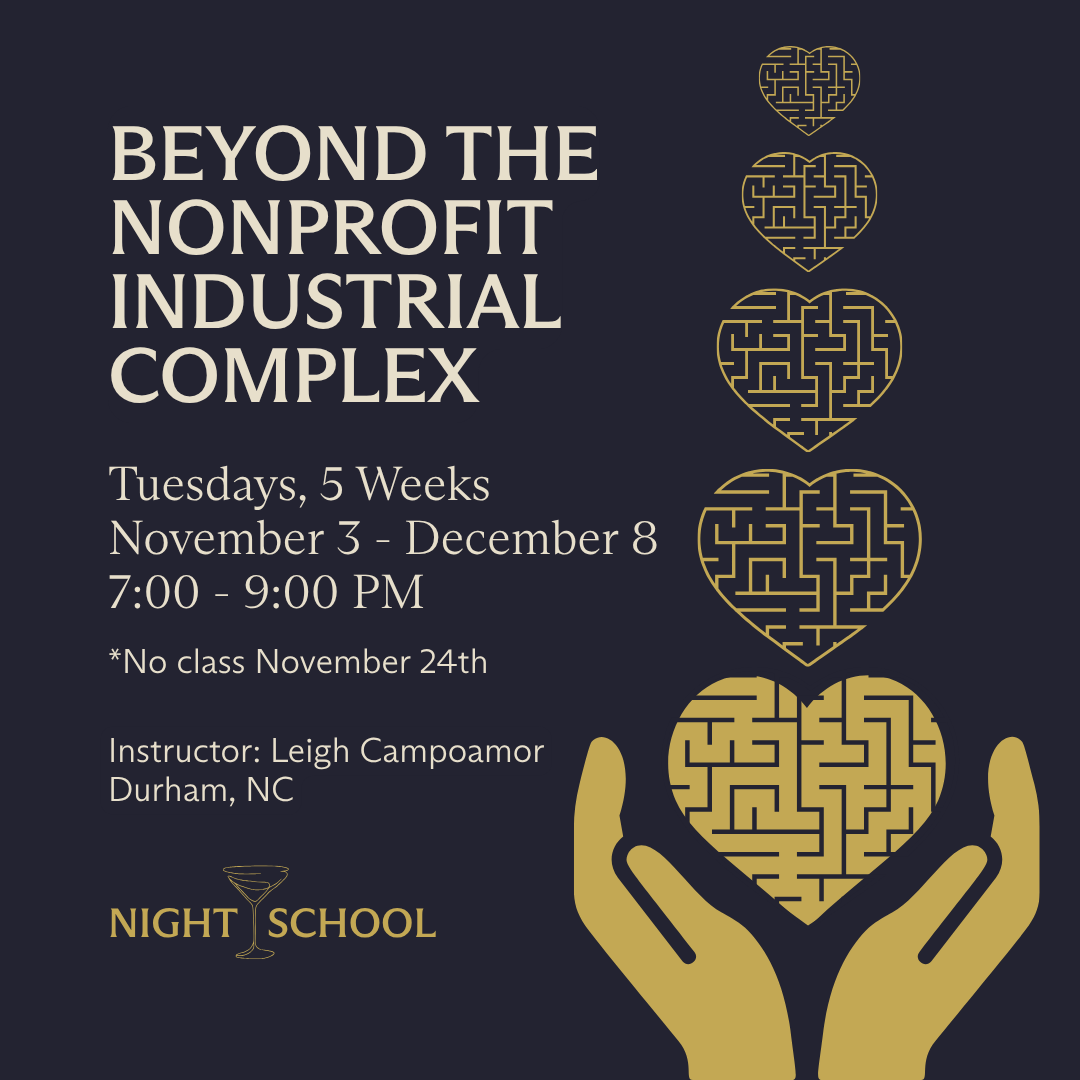
Instructor: Leigh Campoamor | 5 Weeks | Tuesdays | November 3-December 8 (no class Nov 24) | 7:00-9:00 PM | 719 N. Mangum St, Durham NC
The term “nonprofit industrial complex” refers to the ways nonprofits are enmeshed in powerful webs of elite influence from funders, who represent corporate and state interests. Most people who work in the nonprofit sector do it because they value the expressed goals of the organizations, despite constant funding cuts. However, some critics argue that nonprofits don’t serve the historically marginalized communities they claim to, and that they co-opt the language of social movements without effecting social change.
To understand how nonprofits came to dominate the organizing landscape in the U.S., we’ll look at the history of nonprofits and the role they play in contemporary neoliberal capitalism. Questions we will consider include: Does philanthropic funding direct nonprofit work away from community building? Does the need for nonprofits to sustain themselves disrupt their capacities to address systemic problems? Is there a way forward for social justice organizing that doesn’t require professionalization, corporatization, and competition for resources? And how has this all changed post-DOGE?
By sharpening our critique of the nonprofit industrial complex, we’ll also be able to think about possibilities for the future of nonprofits. Together we’ll explore how critiques of the nonprofit industrial complex allow us to ask deeper questions about the world we want to live in. Readings/viewings might include the following authors and organizations: INCITE! Women of Color Against Violence; Dean Spade; Ruth Wilson Gilmore; Andrea Smith; Dylan Rodriguez; and Christine E. Ahn.
—
The Fine Print:
Gift certificates may only be redeemed at the full tuition tier.
SLIDING SCALE TUITION
Full tuition is the cost per-student of running the class. If you choose a tier below full tuition, you are receiving a discount. If you choose to make a donation in addition to full tuition, you are helping to cover the cost for students who are not able to pay the full amount.
The mid-level tier is a discounted rate for people whose household income is at or above living wage but who have limited discretionary income.
The low-level tier and the full-scholarship tier are for people whose household income is below living wage or who need extra assistance to meet their needs.
SCHOLARSHIPS
Through our fundraising efforts, we are able to offer three full scholarships per class. The full-scholarship tier is a nonrefundable offering. Each student may only take one full-scholarship class at a time. Because our scholarship funding is limited, if a student selects multiple overlapping classes at the full-scholarship level, they will be disenrolled from all classes.
All sliding-scale and scholarship needs are self-assessed, and we will never request or require proof of need.
Please see our FAQ for more information, including installment plans, refund policy, and sick and inclement weather policy.
**This course is in-person only. There is no virtual component. Participants must be age 21+
Full Tuition: $340 — Sliding-scale tuition options are available in the drop-down enrollment menu for you to self-select. To pay in installments, choose to pay with PayPal or Klarna at check out.
Instructor: Leigh Campoamor | 5 Weeks | Tuesdays | November 3-December 8 (no class Nov 24) | 7:00-9:00 PM | 719 N. Mangum St, Durham NC
The term “nonprofit industrial complex” refers to the ways nonprofits are enmeshed in powerful webs of elite influence from funders, who represent corporate and state interests. Most people who work in the nonprofit sector do it because they value the expressed goals of the organizations, despite constant funding cuts. However, some critics argue that nonprofits don’t serve the historically marginalized communities they claim to, and that they co-opt the language of social movements without effecting social change.
To understand how nonprofits came to dominate the organizing landscape in the U.S., we’ll look at the history of nonprofits and the role they play in contemporary neoliberal capitalism. Questions we will consider include: Does philanthropic funding direct nonprofit work away from community building? Does the need for nonprofits to sustain themselves disrupt their capacities to address systemic problems? Is there a way forward for social justice organizing that doesn’t require professionalization, corporatization, and competition for resources? And how has this all changed post-DOGE?
By sharpening our critique of the nonprofit industrial complex, we’ll also be able to think about possibilities for the future of nonprofits. Together we’ll explore how critiques of the nonprofit industrial complex allow us to ask deeper questions about the world we want to live in. Readings/viewings might include the following authors and organizations: INCITE! Women of Color Against Violence; Dean Spade; Ruth Wilson Gilmore; Andrea Smith; Dylan Rodriguez; and Christine E. Ahn.
—
The Fine Print:
Gift certificates may only be redeemed at the full tuition tier.
SLIDING SCALE TUITION
Full tuition is the cost per-student of running the class. If you choose a tier below full tuition, you are receiving a discount. If you choose to make a donation in addition to full tuition, you are helping to cover the cost for students who are not able to pay the full amount.
The mid-level tier is a discounted rate for people whose household income is at or above living wage but who have limited discretionary income.
The low-level tier and the full-scholarship tier are for people whose household income is below living wage or who need extra assistance to meet their needs.
SCHOLARSHIPS
Through our fundraising efforts, we are able to offer three full scholarships per class. The full-scholarship tier is a nonrefundable offering. Each student may only take one full-scholarship class at a time. Because our scholarship funding is limited, if a student selects multiple overlapping classes at the full-scholarship level, they will be disenrolled from all classes.
All sliding-scale and scholarship needs are self-assessed, and we will never request or require proof of need.
Please see our FAQ for more information, including installment plans, refund policy, and sick and inclement weather policy.