 Image 1 of 1
HIV/AIDS in the American Imaginary [Durham, NC]
**This course is in-person only. There is no virtual component. Participants must be age 21+
Full Tuition: $340 — Sliding-scale tuition options are available in the drop-down enrollment menu for you to self-select. To pay in installments, choose to pay with PayPal or Klarna at check out.
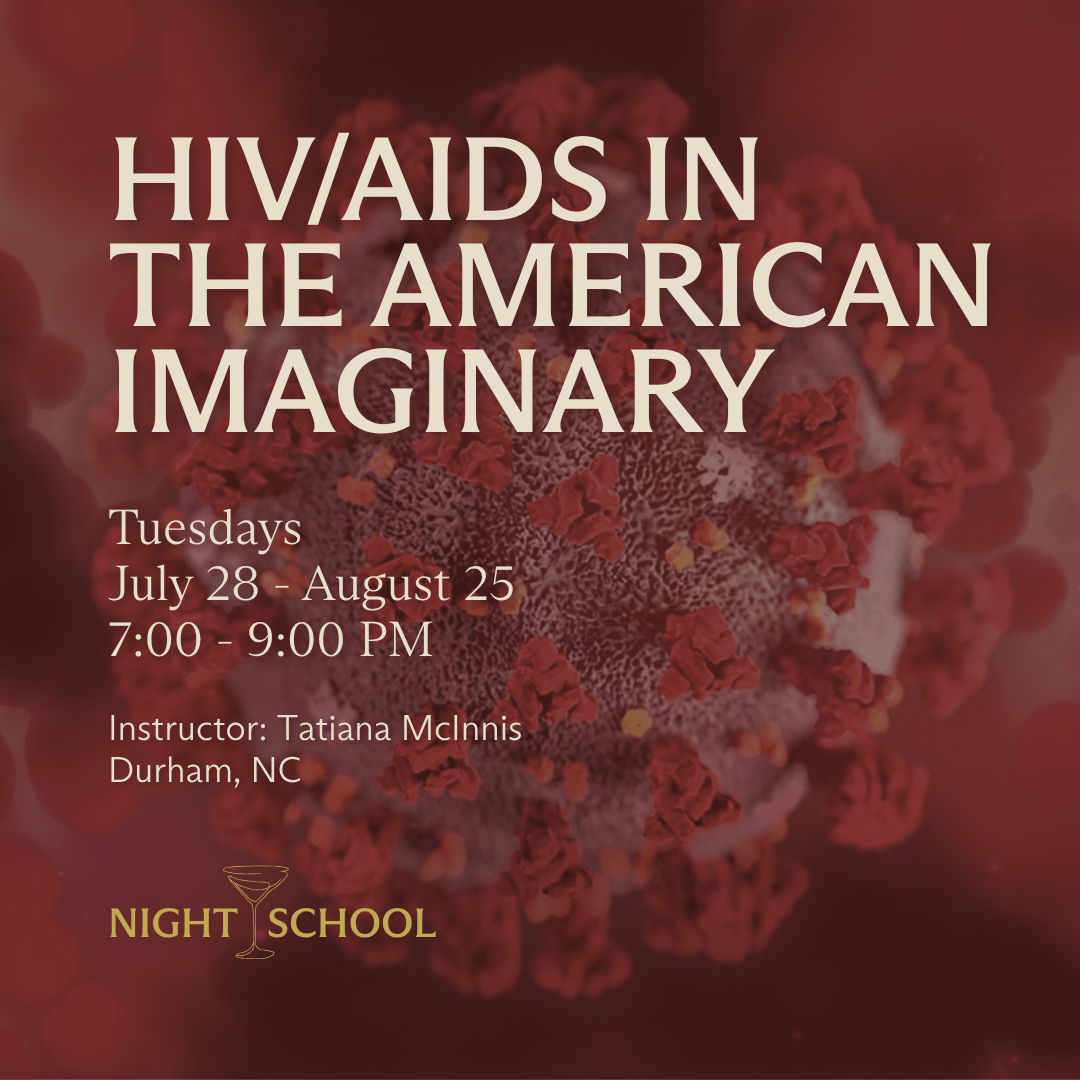
Instructor: Tatiana McInnis | 5-Weeks | Tuesdays | July 28-August 25 | 7:00-9:00 PM | 719 N Mangum St., Durham, NC
The stories generally told about the early days of HIV/AIDS rely on stereotypes of gay promiscuity, drug use, and urban spaces in the U.S. Timelines of the HIV/AIDS pandemic largely trace the beginning of the US outbreak to the late 1970s, culminating with the CDC’s 1981 report about a rare form of pneumonia identified in gay men in Los Angeles. More recently, these stories center pity for people living in the Global South, relying on misconceptions that the pandemic ended with the introduction of HIV treatment.
In fact, the HIV/AIDS pandemic began much earlier–with the 1969 death of a 16 year old black teenager, Robert Rayford, from AIDS related complications. And today, there is an expanding body of literature and art made by and for people living with HIV/AIDS. This class seeks to expand upon and contest conventional stories by examining the HIV/AIDS pandemic as it is represented in a diverse range of media including oral histories, poetry, short stories, and TV shows. Focusing on HIV/AIDS’s disproportionate impact on communities of color, we’ll examine the politics of death, survival, resistance, and representation of an American plague.
Authors/creators explored may include: Essex Hemphill, Danez Smith, Tony Kushner, Rebecca Makkai, Susan Sontag, Rafael Campo, Catherine Cohen, Mary Fisher.
—
The Fine Print:
Gift certificates may only be redeemed at the full tuition tier.
SLIDING SCALE TUITION
Full tuition is the cost per-student of running the class. If you choose a tier below full tuition, you are receiving a discount. If you choose to make a donation in addition to full tuition, you are helping to cover the cost for students who are not able to pay the full amount.
The mid-level tier is a discounted rate for people whose household income is at or above living wage but who have limited discretionary income.
The low-level tier and the full-scholarship tier are for people whose household income is below living wage or who need extra assistance to meet their needs.
SCHOLARSHIPS
Through our fundraising efforts, we are able to offer three full scholarships per class. The full-scholarship tier is a nonrefundable offering. Each student may only take one full-scholarship class at a time. Because our scholarship funding is limited, if a student selects multiple overlapping classes at the full-scholarship level, they will be disenrolled from all classes.
All sliding-scale and scholarship needs are self-assessed, and we will never request or require proof of need.
Please see our FAQ for more information, including installment plans, refund policy, and sick and inclement weather policy.
**This course is in-person only. There is no virtual component. Participants must be age 21+
Full Tuition: $340 — Sliding-scale tuition options are available in the drop-down enrollment menu for you to self-select. To pay in installments, choose to pay with PayPal or Klarna at check out.
Instructor: Tatiana McInnis | 5-Weeks | Tuesdays | July 28-August 25 | 7:00-9:00 PM | 719 N Mangum St., Durham, NC
The stories generally told about the early days of HIV/AIDS rely on stereotypes of gay promiscuity, drug use, and urban spaces in the U.S. Timelines of the HIV/AIDS pandemic largely trace the beginning of the US outbreak to the late 1970s, culminating with the CDC’s 1981 report about a rare form of pneumonia identified in gay men in Los Angeles. More recently, these stories center pity for people living in the Global South, relying on misconceptions that the pandemic ended with the introduction of HIV treatment.
In fact, the HIV/AIDS pandemic began much earlier–with the 1969 death of a 16 year old black teenager, Robert Rayford, from AIDS related complications. And today, there is an expanding body of literature and art made by and for people living with HIV/AIDS. This class seeks to expand upon and contest conventional stories by examining the HIV/AIDS pandemic as it is represented in a diverse range of media including oral histories, poetry, short stories, and TV shows. Focusing on HIV/AIDS’s disproportionate impact on communities of color, we’ll examine the politics of death, survival, resistance, and representation of an American plague.
Authors/creators explored may include: Essex Hemphill, Danez Smith, Tony Kushner, Rebecca Makkai, Susan Sontag, Rafael Campo, Catherine Cohen, Mary Fisher.
—
The Fine Print:
Gift certificates may only be redeemed at the full tuition tier.
SLIDING SCALE TUITION
Full tuition is the cost per-student of running the class. If you choose a tier below full tuition, you are receiving a discount. If you choose to make a donation in addition to full tuition, you are helping to cover the cost for students who are not able to pay the full amount.
The mid-level tier is a discounted rate for people whose household income is at or above living wage but who have limited discretionary income.
The low-level tier and the full-scholarship tier are for people whose household income is below living wage or who need extra assistance to meet their needs.
SCHOLARSHIPS
Through our fundraising efforts, we are able to offer three full scholarships per class. The full-scholarship tier is a nonrefundable offering. Each student may only take one full-scholarship class at a time. Because our scholarship funding is limited, if a student selects multiple overlapping classes at the full-scholarship level, they will be disenrolled from all classes.
All sliding-scale and scholarship needs are self-assessed, and we will never request or require proof of need.
Please see our FAQ for more information, including installment plans, refund policy, and sick and inclement weather policy.