 Image 1 of 1
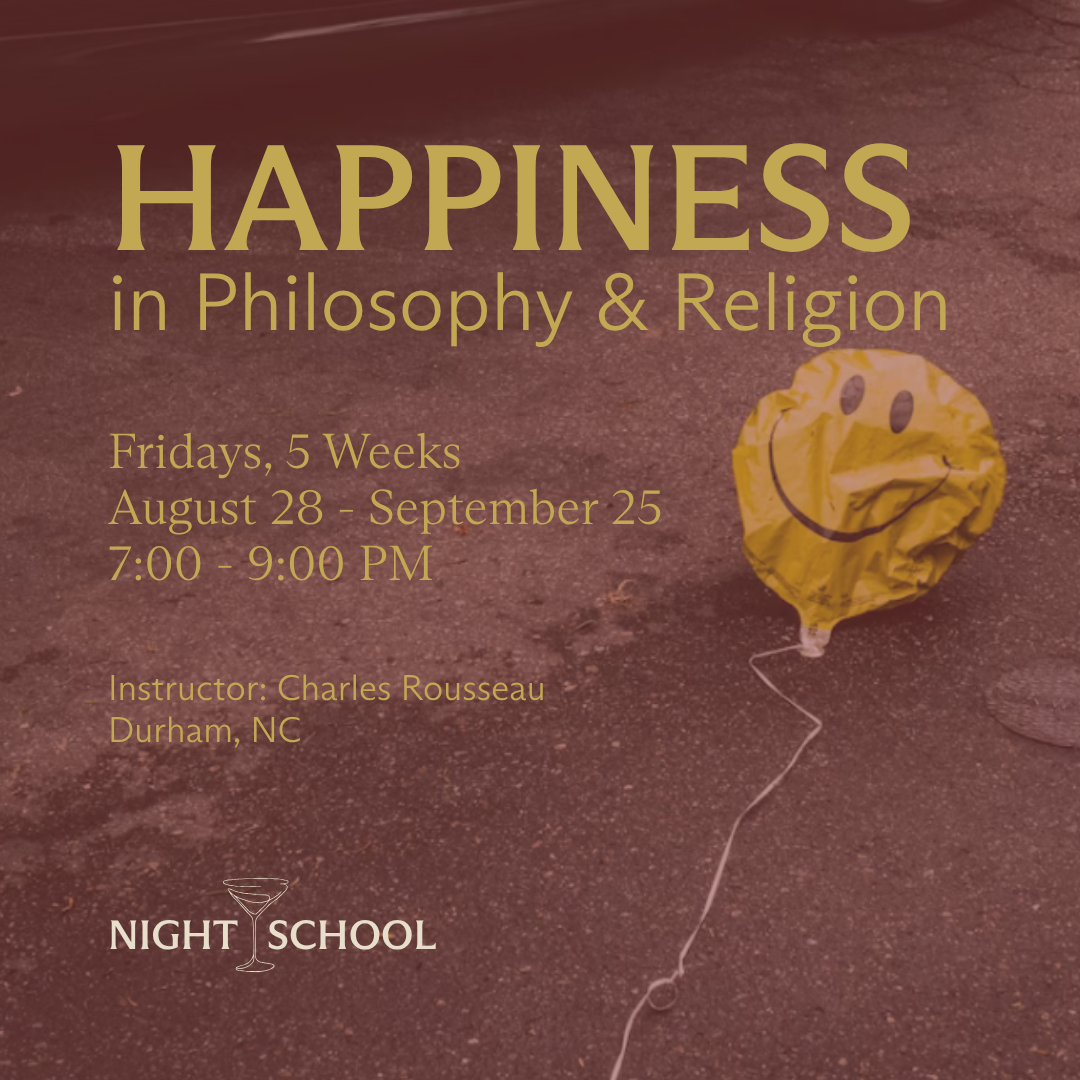
Happiness in Philosophy and Religion [Durham, NC]
**This course is in-person only. There is no virtual component. Participants must be age 21+
Full Tuition: $340 — Sliding-scale tuition options are available in the drop-down enrollment menu for you to self-select. To pay in installments, choose to pay with PayPal or Klarna at check out.
Instructor: Charles Rousseau | 5 Weeks | Fridays | August 28-September 25 | 7:00-9:00 PM | 719 N. Mangum St, Durham NC
What is happiness? What makes it possible, and what value – if any – should we ascribe to it? Are you, yourself, happy?
Happiness often appears as both a promise and a demand. It is invoked as a goal, a measure of success, and a justification for how we organize our lives. Yet it remains difficult to define, unevenly distributed, and elusive. Is happiness a feeling to be cultivated, a virtue to be practiced, a condition shaped by social structure and circumstance, or something else entirely? "Always be optimizing" is one of today's pervasive cultural demands, and the market for self-optimizing is booming. This class asks what happens when our pursuit of happiness becomes its own source of dissatisfaction. Must we imagine Sisyphus happy?
This five-week theory seminar approaches happiness as a philosophical, psychological, and political problem. Part intellectual history and part personal inquiry, the course will explore various traditions that have sought to define the good life, from ancient accounts of flourishing and virtue, to religious visions of fulfillment beyond the self, to modern critiques of happiness as an ideological or disciplinary force. Along the way, we will consider whether happiness is a coherent idea by analyzing how it relates to pleasure, meaning, luck, suffering, and joy. Readings will be drawn from a range of thinkers, which may include Aristotle, Augustine, Michel de Montaigne, Soren Kierkegaard, Jean-Jacques Rousseau, William James, Sigmund Freud, James Baldwin, Simon Critchley, Sara Ahmed, Lauren Berlant, Kate Bowler, and others. Together, we will ask not only what happiness is, but who gets to be happy, and whether we want to be among them.
—
The Fine Print:
Gift certificates may only be redeemed at the full tuition tier.
SLIDING SCALE TUITION
Full tuition is the cost per-student of running the class. If you choose a tier below full tuition, you are receiving a discount. If you choose to make a donation in addition to full tuition, you are helping to cover the cost for students who are not able to pay the full amount.
The mid-level tier is a discounted rate for people whose household income is at or above living wage but who have limited discretionary income.
The low-level tier and the full-scholarship tier are for people whose household income is below living wage or who need extra assistance to meet their needs.
SCHOLARSHIPS
Through our fundraising efforts, we are able to offer three full scholarships per class. The full-scholarship tier is a nonrefundable offering. Each student may only take one full-scholarship class at a time. Because our scholarship funding is limited, if a student selects multiple overlapping classes at the full-scholarship level, they will be disenrolled from all classes.
All sliding-scale and scholarship needs are self-assessed, and we will never request or require proof of need.
Please see our FAQ for more information, including installment plans, refund policy, and sick and inclement weather policy.
**This course is in-person only. There is no virtual component. Participants must be age 21+
Full Tuition: $340 — Sliding-scale tuition options are available in the drop-down enrollment menu for you to self-select. To pay in installments, choose to pay with PayPal or Klarna at check out.
Instructor: Charles Rousseau | 5 Weeks | Fridays | August 28-September 25 | 7:00-9:00 PM | 719 N. Mangum St, Durham NC
What is happiness? What makes it possible, and what value – if any – should we ascribe to it? Are you, yourself, happy?
Happiness often appears as both a promise and a demand. It is invoked as a goal, a measure of success, and a justification for how we organize our lives. Yet it remains difficult to define, unevenly distributed, and elusive. Is happiness a feeling to be cultivated, a virtue to be practiced, a condition shaped by social structure and circumstance, or something else entirely? "Always be optimizing" is one of today's pervasive cultural demands, and the market for self-optimizing is booming. This class asks what happens when our pursuit of happiness becomes its own source of dissatisfaction. Must we imagine Sisyphus happy?
This five-week theory seminar approaches happiness as a philosophical, psychological, and political problem. Part intellectual history and part personal inquiry, the course will explore various traditions that have sought to define the good life, from ancient accounts of flourishing and virtue, to religious visions of fulfillment beyond the self, to modern critiques of happiness as an ideological or disciplinary force. Along the way, we will consider whether happiness is a coherent idea by analyzing how it relates to pleasure, meaning, luck, suffering, and joy. Readings will be drawn from a range of thinkers, which may include Aristotle, Augustine, Michel de Montaigne, Soren Kierkegaard, Jean-Jacques Rousseau, William James, Sigmund Freud, James Baldwin, Simon Critchley, Sara Ahmed, Lauren Berlant, Kate Bowler, and others. Together, we will ask not only what happiness is, but who gets to be happy, and whether we want to be among them.
—
The Fine Print:
Gift certificates may only be redeemed at the full tuition tier.
SLIDING SCALE TUITION
Full tuition is the cost per-student of running the class. If you choose a tier below full tuition, you are receiving a discount. If you choose to make a donation in addition to full tuition, you are helping to cover the cost for students who are not able to pay the full amount.
The mid-level tier is a discounted rate for people whose household income is at or above living wage but who have limited discretionary income.
The low-level tier and the full-scholarship tier are for people whose household income is below living wage or who need extra assistance to meet their needs.
SCHOLARSHIPS
Through our fundraising efforts, we are able to offer three full scholarships per class. The full-scholarship tier is a nonrefundable offering. Each student may only take one full-scholarship class at a time. Because our scholarship funding is limited, if a student selects multiple overlapping classes at the full-scholarship level, they will be disenrolled from all classes.
All sliding-scale and scholarship needs are self-assessed, and we will never request or require proof of need.
Please see our FAQ for more information, including installment plans, refund policy, and sick and inclement weather policy.