 Image 1 of 1
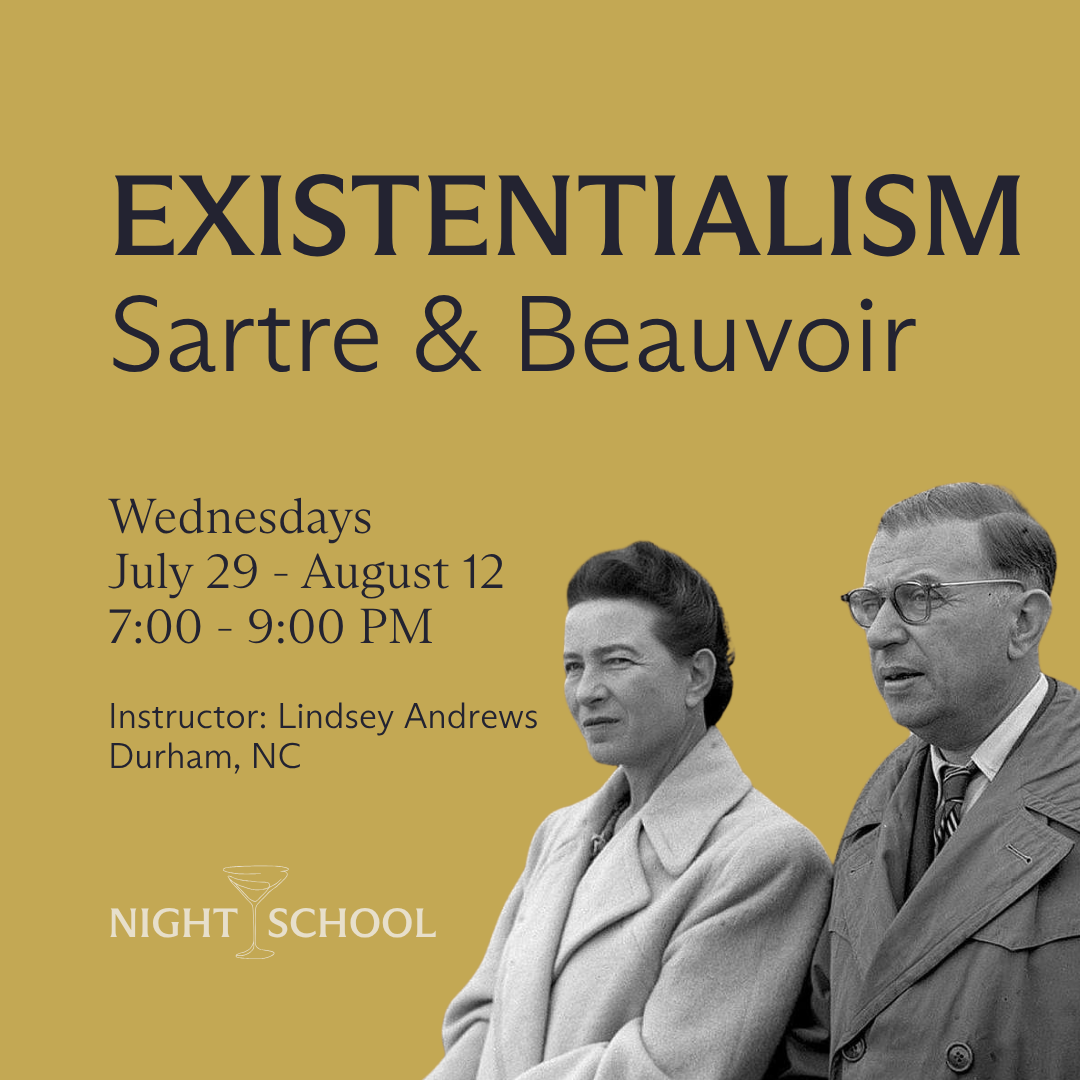
Existentialism: Sartre and Beauvoir [Durham, NC]
**This course is in-person only. There is no virtual component. Participants must be age 21+
Full Tuition: $225 — Sliding-scale tuition options are available in the drop-down enrollment menu for you to self-select. To pay in installments, choose PayPal or Klarna at check out.
Instructor: Lindsey Andrews | 3-Weeks | Wednesdays | July 29-August 12 | 7:00-9:00 PM | 719 N Mangum St., Durham, NC
How does life gain meaning? Are we free to make our own choices, and if so, how can we know what choice to make? Where should our ethics come from? What makes us human? These are some questions that European Existentialist philosophers grappled with in the years immediately following the Second World War.
In 1945, the philosopher Jean Paul Sartre delivered a lecture entitled “Existentialism Is a Humanism.” It was the first time that he adopted the label “Existentialist,” which would retroactively be applied to other writers, including Soren Kierkegaard and Fyodor Doestoyevsky. In the lecture, Sartre espoused one of the school’s key tenets, “existence precedes essence,” and highlighted central concerns about how we as human beings find meaning and make choices. Within a few years, Simone de Beauvoir, a close interlocutor of Sartre’s, brought important feminist insights to bear on Existentialist thought, introducing ambiguity (rather than absurdity) as a key concept for ethically wielding our freedom.
Over the course of three weeks, we will read work from these two foundational French Existentialists, including Sartre’s original lecture in its entirety and excerpts from Beauvoir’s landmark feminist texts, The Second Sex and The Ethics of Ambiguity. We’ll learn about key ideas of Existentialism in order to examine it in context, asking why Existentialism emerged in Europe in the post-war moment, and what it can say to us today. Students do not need any prior experience or training in philosophy to take this class.
—
The Fine Print:
Gift certificates may only be redeemed at the full tuition tier.
SLIDING SCALE TUITION
Full tuition is the cost per-student of running the class. If you choose a tier below full tuition, you are receiving a discount. If you choose to make a donation in addition to full tuition, you are helping to cover the cost for students who are not able to pay the full amount.
The mid-level tier is a discounted rate for people whose household income is at or above living wage but who have limited discretionary income.
The low-level tier and the full-scholarship tier are for people whose household income is below living wage or who need extra assistance to meet their needs.
SCHOLARSHIPS
Through our fundraising efforts, we are able to offer three full scholarships per class. The full-scholarship tier is a nonrefundable offering. Each student may only take one full-scholarship class at a time. Because our scholarship funding is limited, if a student selects multiple overlapping classes at the full-scholarship level, they will be disenrolled from all classes.
All sliding-scale and scholarship needs are self-assessed, and we will never request or require proof of need.
Please see our FAQ for more information, including installment plans, refund policy, and sick and inclement weather policy.
**This course is in-person only. There is no virtual component. Participants must be age 21+
Full Tuition: $225 — Sliding-scale tuition options are available in the drop-down enrollment menu for you to self-select. To pay in installments, choose PayPal or Klarna at check out.
Instructor: Lindsey Andrews | 3-Weeks | Wednesdays | July 29-August 12 | 7:00-9:00 PM | 719 N Mangum St., Durham, NC
How does life gain meaning? Are we free to make our own choices, and if so, how can we know what choice to make? Where should our ethics come from? What makes us human? These are some questions that European Existentialist philosophers grappled with in the years immediately following the Second World War.
In 1945, the philosopher Jean Paul Sartre delivered a lecture entitled “Existentialism Is a Humanism.” It was the first time that he adopted the label “Existentialist,” which would retroactively be applied to other writers, including Soren Kierkegaard and Fyodor Doestoyevsky. In the lecture, Sartre espoused one of the school’s key tenets, “existence precedes essence,” and highlighted central concerns about how we as human beings find meaning and make choices. Within a few years, Simone de Beauvoir, a close interlocutor of Sartre’s, brought important feminist insights to bear on Existentialist thought, introducing ambiguity (rather than absurdity) as a key concept for ethically wielding our freedom.
Over the course of three weeks, we will read work from these two foundational French Existentialists, including Sartre’s original lecture in its entirety and excerpts from Beauvoir’s landmark feminist texts, The Second Sex and The Ethics of Ambiguity. We’ll learn about key ideas of Existentialism in order to examine it in context, asking why Existentialism emerged in Europe in the post-war moment, and what it can say to us today. Students do not need any prior experience or training in philosophy to take this class.
—
The Fine Print:
Gift certificates may only be redeemed at the full tuition tier.
SLIDING SCALE TUITION
Full tuition is the cost per-student of running the class. If you choose a tier below full tuition, you are receiving a discount. If you choose to make a donation in addition to full tuition, you are helping to cover the cost for students who are not able to pay the full amount.
The mid-level tier is a discounted rate for people whose household income is at or above living wage but who have limited discretionary income.
The low-level tier and the full-scholarship tier are for people whose household income is below living wage or who need extra assistance to meet their needs.
SCHOLARSHIPS
Through our fundraising efforts, we are able to offer three full scholarships per class. The full-scholarship tier is a nonrefundable offering. Each student may only take one full-scholarship class at a time. Because our scholarship funding is limited, if a student selects multiple overlapping classes at the full-scholarship level, they will be disenrolled from all classes.
All sliding-scale and scholarship needs are self-assessed, and we will never request or require proof of need.
Please see our FAQ for more information, including installment plans, refund policy, and sick and inclement weather policy.