Kristen Waters
Here I offer a cursory brushstroke toward understanding our dreams in combination with an invitation toward somatic awareness around the recollection of our dreams. With curiosity, I entertain what both Freud and Lacan put forth regarding dream interpretation, along with inviting intentional mind-body connection in our waking life with what remains with us from our dreaming life. This primer is less interested in what is right or true, and more so about what resonates with the connections you make to your dreams, and what might want to continue to integrate through somatic practice.
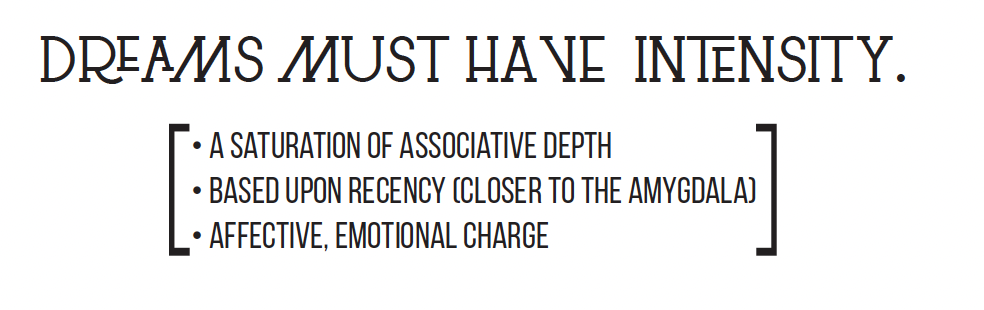
Dreams always hold importance. There is no arbitrary trifle in dreams. No dream is neutral. Dreams give us a look into our unconscious.
For Freud, dreams are fundamentally guardians of sleep, extinguishing all external and internal stimuli. In order to stay asleep, any strong negative emotions, forbidden thoughts and unconscious desires have to be disguised or censored in some form or another so as not to disturb or awaken the dreamer. For Lacan, our unconscious is like the censored parts of a biography. Dreaming is intertwined in our language, communicating with us. He thought that most often images in dreams represent those with whom we identify ourselves in childhood, and in most cases, every dream is an address to a significant other in one’s life — a family member, a friend, or, if the dreamer is in analysis then the other is the analyst. The issue of the ego is crucial in dream interpretation in the sense that all figures in the dream are the ego identifications of the dreamer. And the ego is a mask whose function is to censor and repress the articulation of unconscious desire. According to Lacan, the image that awakes the dreamer is the one that brings us the closest to the realm of the dreamer’s disappearance of the ego. It is exactly the anxiety of this encounter that precipitates the escape into our waking life. “To have an unconscious is to be or to make oneself radically odd to oneself, to always be in and out of character,” writes Adam Phillips.
Freud thought of dreams as protectors of sleep, while Lacan found it interesting to look for what wakes the dreamer.
For both Freud and Lacan, a dream is composed of two parts—the manifest and the latent content. The manifest content is what the dream seems to be saying, which is often bizarre and nonsensical, while the latent content is what the dream is really trying to say. Both consider the manifest content as nothing but the latent content in disguise, making connections between what appears in the dream and what the dream is truly saying.
Freud believed that we can chip through the dream's manifest content to reveal the underlying significance by utilizing "free association". To use this technique, you start with one dream image and follow what automatically comes to your mind first, and then keep going in this manner, like dominos, and see where it leads. In the process Freud called "dream work," latent content is transformed into manifest content through processes which disguise and distort the latent thoughts.
Freud posed types of distorted processes used to interpret images in our dreams. Dream interpretation happens through turning what is clear or obvious into what has yet to be developed. With somatic intention, we can welcome curiosity toward what exists in the present moment yet might be hidden or undiscovered. We can learn to trust our mind-body connection to make clear only what we can handle bit by bit.
Condensation omits or hides feelings or urges by underplaying or contracting into a brief dream image or event. Here we condense multiple meanings or use associations to connect all the parts, like a fungal web that shoots up a dense mushroom.
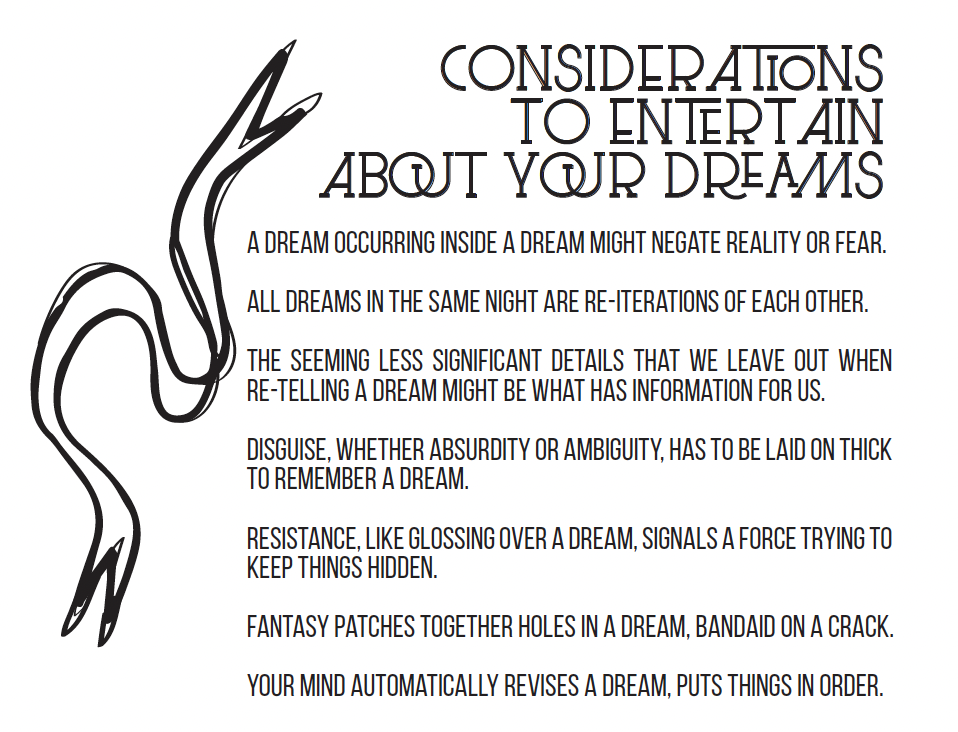
Distortion happens through reversals and displacements. Displacement occurs by placing intensity onto something vague, meaningless, or unrelated, in order to disguise the content so you can recall your dream. You can’t always trust where intense emotion is located in a dream. A magician might misdirect you. For Lacan, metaphor is structurally similar to condensation and metonymy to displacement. Because the laws of dreaming are the laws of language, he rejected anything that may appear as “an intuitive approach” to dream interpretation. There is no arbitrariness in dreams. The structure can be revealed, even as there is always something that also cannot be recalled upon awakening.
“To improve society, spend more time with people you haven’t
met. The person one hasn’t met is also always oneself.”
About dream interpretation
A key point of dream interpretation is to uncover these identifications, recognize them for what they are, and, in doing so, give expression to the unconscious desire they are articulating. The articulation of the unconscious desire means bringing the dreamer closer toward the knowledge of the unconscious, which, according to both Freud and Lacan, represents the true motivating source of our actions. Adam Phillips clarifies, “ Each psychoanalytic theorist starting with Freud describes a set of essential terrors, that which it is assumed people cannot bear to remember, experience, or know. These define what it means to be human, or what, in order to be human, one feels obliged to exclude. Psychoanalytic theory is a theory of the unbearable, of what one prefers not to know.” As far as the method of interpretation goes, one must treat the text of the dream as a censored but sacred text, because, as Lacan put it, “What [the dream] articulates as not to be said is precisely what it has to say.” Therefore, all that transpires in the dream is to be read as trying to make sense of the fact of human mortality, the fact of death. Phillips continues, “There is no cure for the unconscious, no solution for unconscious desire. Knowledge can’t put a stop to that, only death can.”

Dreams are an important part of helping the brain to process and integrate traumatic experiences. As there are no neutral dreams, when we recollect a dream with strong emotional or sensory content, we can invite conscious awareness to our body in the present moment, as an invitation toward helping release stored survival energy and complete unfinished stress responses. Dreams often carry somatic cues like physical sensations, movements, or feelings that reflect the body's attempt to process past experiences.
Orienting in your waking life can resolve a dream memory
We can do this by joining our interoceptive awareness (the perception of sensations coming from inside the body) and then rock our attention to join our proprioceptive awareness (the sensing of how one's own body is positioned and moving in time and space), which provides connective feedback to the brain from the body and invites a flowing rhythm our nervous system craves.
As you recall a dream image or sequence, you might pause to notice what the experience feels like inside your body. Perhaps your legs feel disconnected or rigid, for example. You’re just paying attention to what you notice without changing anything. After a moment, direct your attention outward to look with your eyes and head and visually connect with your legs in the present moment. As you engage your muscles or imagine a type of mobilization that was missing in a dream, for example, notice how your body responds.

In this practice, you will notice how your body feels when recalling a dream. You’ll track sensations, emotions and impulses that arise, as these give information about where your body might hold trauma and how it might begin to release. Inviting conscious awareness to dreams can create embodied experiences that support healing when approached with curiosity and presence.
To begin
Take a moment to create a tether that will anchor you to the present moment, like imagining something that might root you (whether an image of tree roots or looking down to find your legs and feet on the ground), as well as to create a container to help hold your experience by taking a moment to look around your environment, noticing an object that you can find to land back in the present moment, if you need it.
Gently recall the dream you want to work with, and allow it to softly drift around in your mind without eforting toward any details. Allow images, emotions, or sensations to come into focus, even as other parts may be less clear. Just work with what's here in the present moment. Give yourself some time to see what surfaces. It might only be one image or one emotion (or emotion that’s missing) that we can remember from a dream, which is enough information to invite curiosity and presence toward.
Begin to track
your body's reaction or sensations to the recalling of the dream. Shift your attention from the story of the dream to what's happening in your body as you recall it. Do you feel tightness, warmth, tingling, heaviness, or lightness anywhere? There’s nothing to force, just an invitation to notice. Are there shifts in your breathing, heart rate or posture? You’re not trying to change anything, just notice. Gently observe any emotions that may surface as well. Is there fear, sadness, relief, curiosity, or even numbness? Welcome some space for any feelings without trying to analyze or fix anything. Then allow your awareness to shift between any intense sensations or emotions to a more neutral or pleasant one. If the dream brings up something overwhelming, pause, and try to locate somewhere inside your body or your surroundings that are even just a tiny bit more okay. We are looking to restore a flowing rhythmic movement back and forth between an edge of the overwhelm, briefly saying hello to it, and then rocking your attention back again to notice the something that is more okay. This back and forth, or pendulation, helps to regulate the nervous system. Your body may have an impulse to move. Maybe there's something like reaching, pushing, using your voice, curling up—expressions of the body's attempt to complete some kind of response that got interrupted. Taking all the time that you need, and only if it’s manageable, see if you can follow any impulse slowly and mindfully and just notice how it feels.
When you feel ready
see if you can soften your vision to spread your attention back into your tether or container, arriving you into the present moment, as you sense for any experience of completion that might feel different in your body. Take a moment to let your eyes, head and neck look around the room. Perhaps name a few objects you see, or rub your fingertips together. This process honors dreams as embodied experiences, allowing the nervous system to release trapped energy without getting stuck in the mental analysis. •
Kristen Waters is a somatic experiencing practitioner in Durham, NC. She is interested in a blend of psychoanalysis and somatics, which served as an impetus for taking the Interpretation of Dreams class with Margot Stillman, as well as her interest in generalizing information and practices in resonance with the way that NSB offers accessible and affordable classes.